Goal Planning
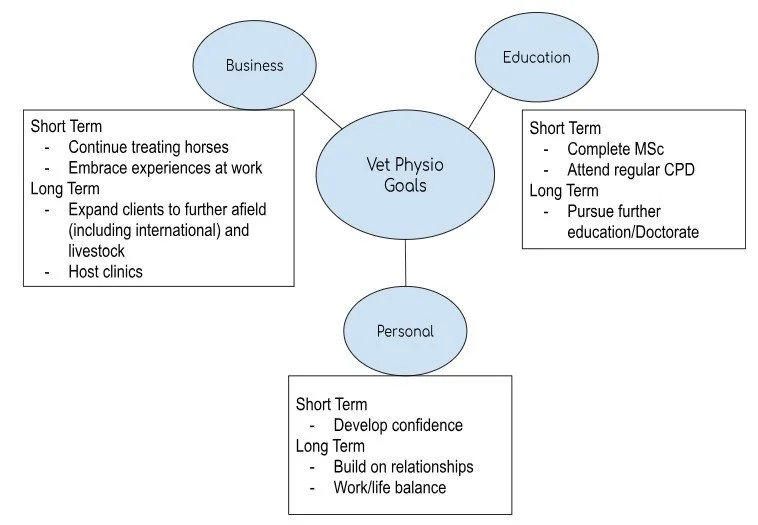
My long term professional goals involve expansion of my scope of practice to include less-typical patients, predominantly livestock, whilst continuing to develop myself as an equine and canine physiotherapist whilst always placing emphasis on long-term wellbeing and quality of life. Studies have shown that students who have interest in or gain enjoyment from a subject will be positively impacted academically and are more likely to be successful (Filgona et al., 2020). My passion for optimising animal function will provide me with the drive to strive for excellence in my studies, based on motivational theory (Gopalan et al., 2017).
S.M.A.R.T.(E.R.) goals are developed using a framework to create realistic and measurable milestones, with trackable progress. To align with this, goals should be; Specific, Measurable, Ambitious, Relevant and Time-bound, with progress tracked using Evaluation and Recognising/Rewarding goal attainment (Bowman et al., 2015). As someone who finds self-reflection and goal setting challenging, this structure is imperative to meeting my goals.
SWOT Analysis
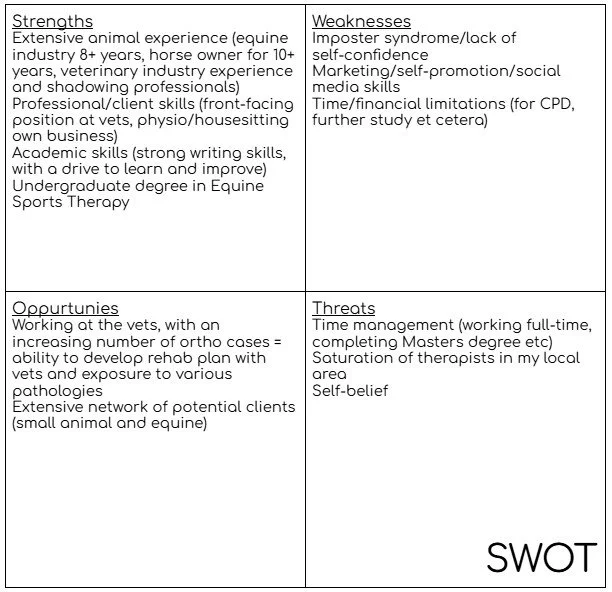
SWOT analysis is used as part of a development plan for an individual or organisation, assessing strengths and weaknesses to highlight areas for growth. The adaptability of the model allows for its use across a multitude of industries, creating structured goal plans with easy progress monitoring (Namugenyi et al., 2019).
Short Term Goals
In the imminent future (the next 1-2 years), my focus lies with completion of this degree to the best of my ability whilst developing my species-specific knowledge and increasing confidence in my ability. I will do this by treating a small number of horses each month and fully engaging in learning opportunities offered to me at the vets. I have found that consistent use of my skills and knowledge helps to maintain my confidence.
Creating this portfolio will not only showcase the steps I have taken to aid my development, but will also remind me of my own dedication and expanse of knowledge; I know I am prone to forgetting my own capabilities and this affects my confidence. These experiences include shadowing multiple professionals (including an equine/canine osteopath, an equine physiotherapist and a remedial farrier), completing further courses and furthering my training/rehabilitation experience through a number of personal project horses.
Linking Goals to Current Practice
My short, medium and long-term goals have all been planned carefully, combining my strengths and opportunities whilst highlighting areas I can improve. Each of these goals have been outlined in a mind-map, offering visual breakdowns of my academic, professional and personal goals relating to my career as a veterinary physiotherapist.
Through the construction of this e-portfolio, I know I am adaptable, empathetic and driven to find the best approach to each of my patients. I have also identified the areas I need to work on beyond my self-belief as discussed previously; my marketing, social media and client relation management is something I must continue to develop to ensure the success of my business.
TOWS Matrix
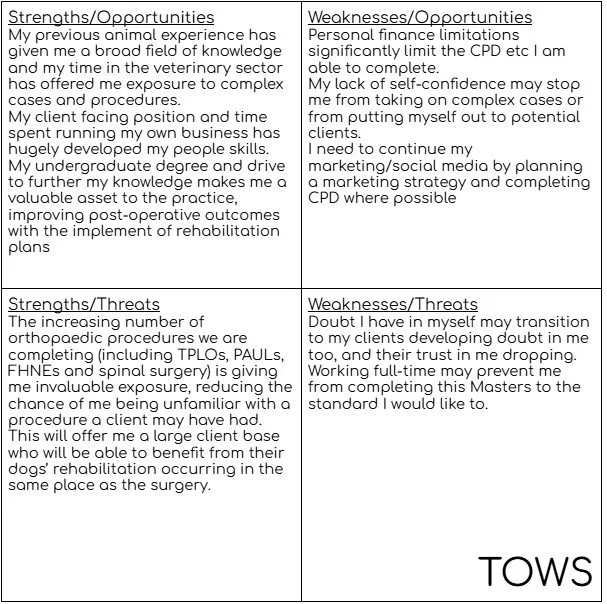
The TOWS matrix is similar to SWOT analysis but builds on the idea by identifying both internal and external threats and opportunities. Use of this will allow for identification of my own growth-influencing factors whilst analysing other areas that will help or hinder me reaching my goals (Ravanavar and Charantimath, 2012).
Medium Term Goals
After graduation in 2028, my professional goals involve the development of both my canine and equine practice. I intend to do this by consolidating my position at the growing small animal practice where I currently work and I hope to offer physiotherapy sessions at all three of our sites.
I will also develop my equine client base through my online presence/marketing and furthering my relationship with my existing clientele; I have recently extended my treatment radius to include a long-standing client’s growing livery yard in Hertfordshire and I hope this partnership will continue progressing.
Academically I will continue with my learning through regular attendance to CPD events (focussing primarily on anatomy and biomechanics as these are areas I would like to work on), and exposing myself to complex cases at work.
Long Term Goals
By 2035, I would like to have expanded my client base to include livestock; I believe veterinary physiotherapy could greatly improve the welfare of farm animals with neurological deficits, lameness and showing/breeding responsibilities. I will do this by building on my pre-existing relationships with local farmers/owners whilst developing my ability and techniques on my own animals.
In Summer 2025, I was fortunate to take a trip to Canada where I was introduced by family to a number of local equine trainers at boarding facilities; I was able to treat a small number of horses and enter into some truly interesting conversations regarding the place of physiotherapy in a horse’s maintenance and wellbeing regime. I hope to nurture these relationships in the coming years with the end goal of hosting clinics combining my skillset with theirs and eventually a relocation (temporary or permanent is undecided as of yet!).
Beyond the next 10 years, I anticipate further developments in the world of animal sciences, and I would like to contribute to this through the possible pursuit of a Doctorate, and incorporation of research into my practice whilst maintaining a realistic work-life balance to prevent deterioration in my passion.